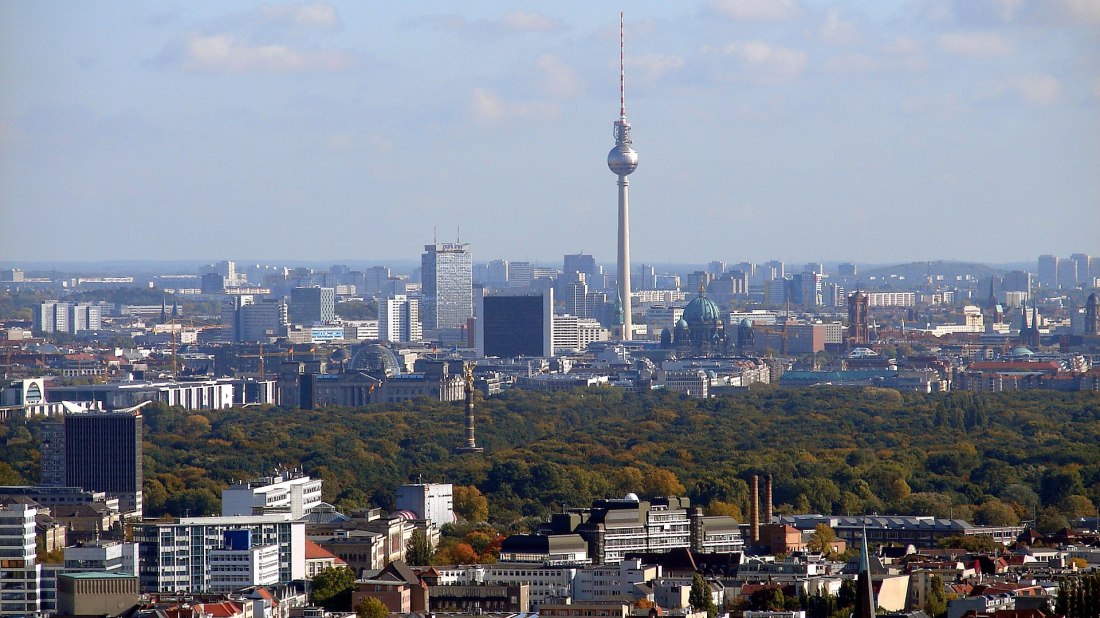
Berlin, Germany
Berlin is the capital and largest city of Germany by both area and population. Its 3,723,914 (2018) inhabitants make it the second most populous city proper of the European Union after London. The city is one of Germany’s 16 federal states. It is surrounded by the state of Brandenburg, and contiguous with its capital, Potsdam. The two cities are at the center of the Berlin/Brandenburg Metropolitan Region, which is, with 6,004,857 (2015) inhabitants and an area of 30,370 square km, Germany’s third-largest metropolitan region after the Rhine-Ruhr and Rhine-Main regions.
Berlin straddles the banks of the River Spree, which flows into the River Havel (a tributary of the River Elbe) in the western borough of Spandau. Among the city’s main topographical features are the many lakes in the western and southeastern boroughs formed by the Spree, Havel, and Dahme rivers (the largest of which is Lake Müggelsee). Due to its location in the European Plain, Berlin is influenced by a temperate seasonal climate. About one-third of the city’s area is composed of forests, parks, gardens, rivers, canals and lakes. The city lies in the Central German dialect area, the Berlin dialect being a variant of the Lusatian-New Marchian dialects.
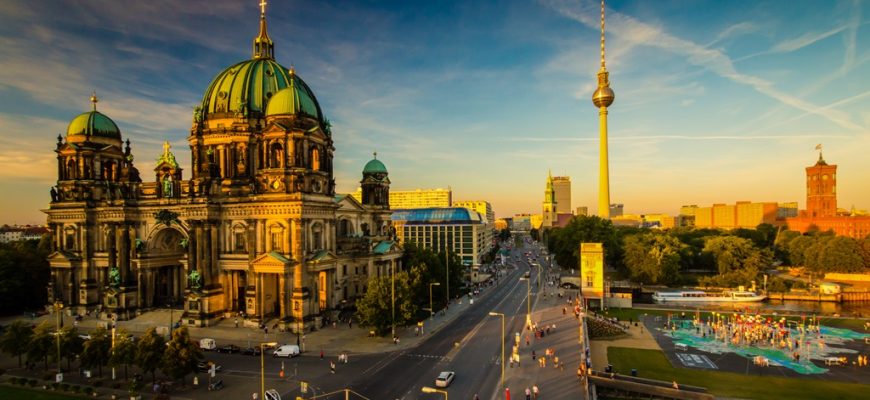
First documented in the 13th century and situated at the crossing of two important historic trade routes, Berlin became the capital of the Margraviate of Brandenburg (1417–1701), the Kingdom of Prussia (1701–1918), the German Empire (1871–1918), the Weimar Republic (1919–1933), and the Third Reich(1933–1945). Berlin in the 1920s was the third largest municipality in the world. After World War II and its subsequent occupation by the victorious countries, the city was divided; West Berlin became a de facto West German exclave, surrounded by the Berlin Wall (1961–1989) and East German territory. East Berlin was declared capital of East Germany, while Bonn became the West German capital. Following German reunification in 1990, Berlin once again became the capital of all of Germany.
Berlin is a world city of culture, politics, media and science. Its economy is based on high-tech firms and the service sector, encompassing a diverse range of creative industries, research facilities, media corporations and convention venues. Berlin serves as a continental hub for air and rail traffic and has a highly complex public transportation network. The metropolis is a popular tourist destination. Significant industries also include IT, pharmaceuticals, biomedical engineering, clean tech, biotechnology, construction and electronics.
Berlin is home to world-renowned universities, orchestras, museums, and entertainment venues, and is host to many sporting events. Its Zoological Garden is the most visited zoo in Europe and one of the most popular worldwide. With the world’s oldest large-scale movie studio complex, Berlin is an increasingly popular location for international film productions. The city is well known for its festivals, diverse architecture, nightlife, contemporary arts and a very high quality of living. Since the 2000s Berlin has seen the emergence of a cosmopolitan entrepreneurial scene.
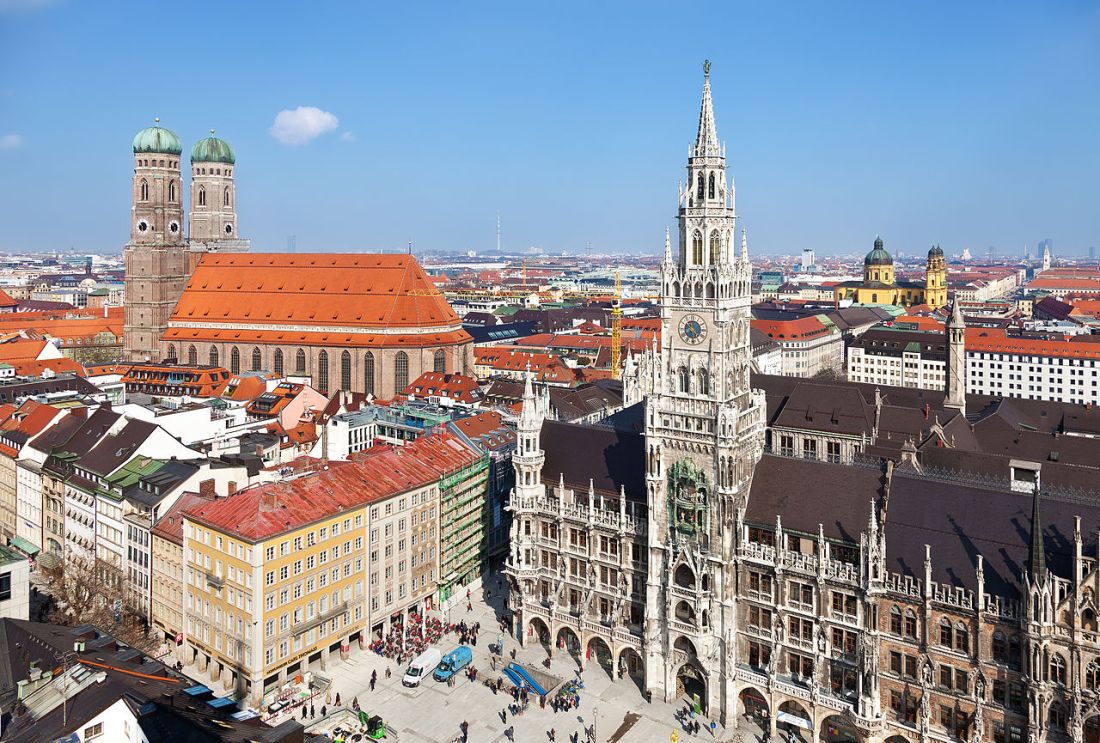
Munich, Germany
Munich is the capital and most populous city of the second most populous German federal state of Bavaria, and, with a population of around 1.5 million, it is the third-largest city of Germany after Berlin and Hamburg, as well as the 12th-largest city in the European Union. The city’s metropolitan region is home to 6 million people. Straddling the banks of the River Isar (a tributary of the Danube) north of the Bavarian Alps, it is the seat of the Bavarian administrative region of Upper Bavaria, while being the most densely populated municipality in Germany (4,500 people per km²). Munich is the second-largest city in the Bavarian dialect area, after the Austrian capital of Vienna.
The city is a major centre of art, technology, finance, publishing, culture, innovation, education, business, and tourism in Germany and Europe and enjoys a very high standard and quality of living, reaching first in Germany and third worldwide according to the 2018 Mercer survey, and being rated the world’s most liveable city by the Monocle’s Quality of Life Survey 2018. According to the Globalization and World Rankings Research Institute Munich is considered an alpha-world city, as of 2015.
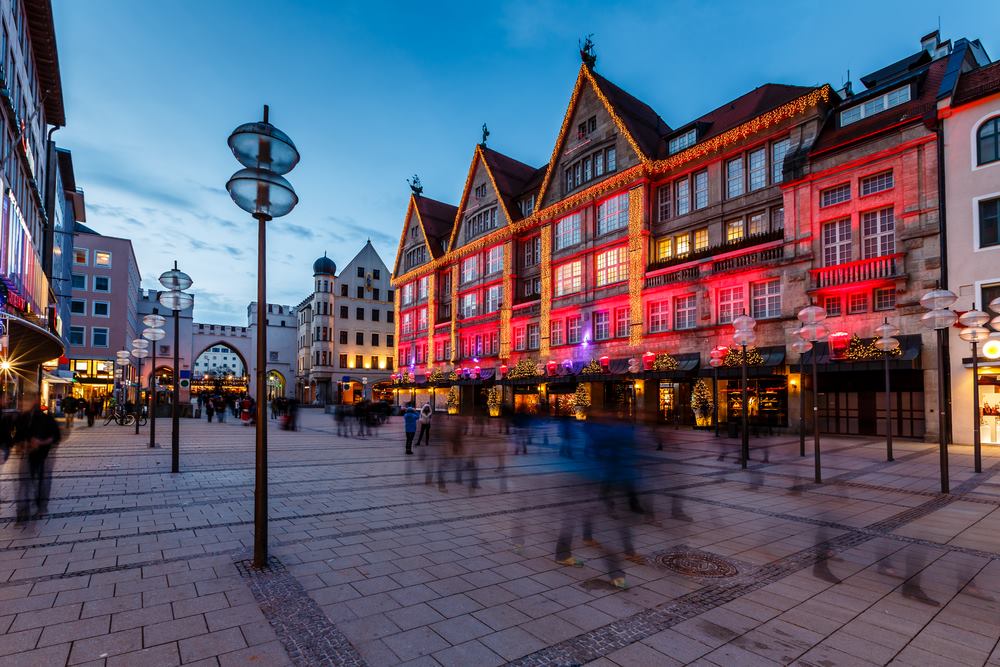
The name of the city is derived from the Old/Middle High German term Munichen, meaning “by the monks”. It derives from the monks of the Benedictine order, who ran a monastery at the place that was later to become the Old Town of Munich; hence the monk depicted on the city’s coat of arms. Munich was first mentioned in 1158. Catholic Munich strongly resisted the Reformation and was a political point of divergence during the resulting Thirty Years’ War, but remained physically untouched despite an occupation by the Protestant Swedes. Once Bavaria was established as a sovereign kingdom in 1806, it became a major European centre of arts, architecture, culture and science. In 1918, during the German Revolution, the ruling house of Wittelsbach, which had governed Bavaria since 1180, was forced to abdicate in Munich and a short-lived socialist republic was declared.
In the 1920s, Munich became home to several political factions, among them the NSDAP. The first attempt of the Nazi movement to take over the German government in 1923 with the Beer Hall Putsch was stopped by the Bavarian police in Munich with gunfire. After the Nazis’ rise to power, Munich was declared their “Capital of the Movement”. During World War II, Munich was heavily bombed and more than 50% of the entire city and up to 90% of the historic centre were destroyed.
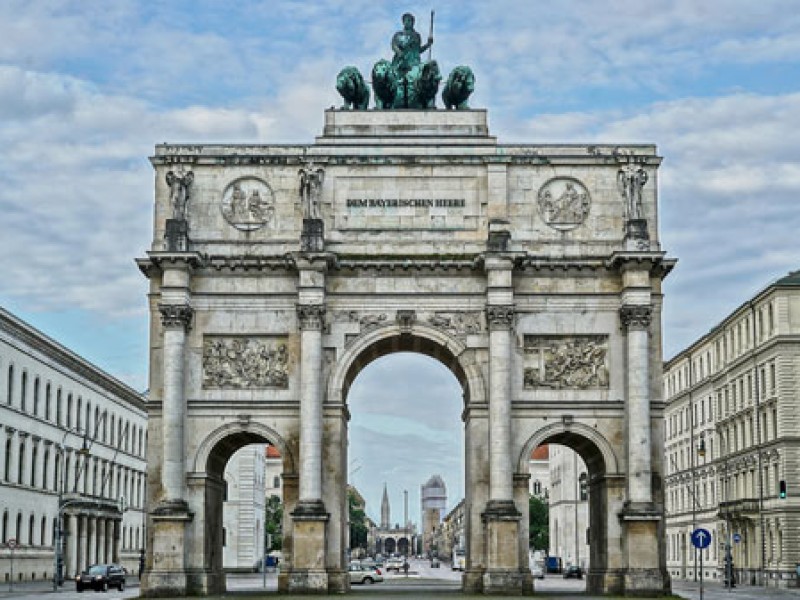
After the end of postwar American occupation in 1949, there was a great increase in population and economic power during the years of Wirtschaftswunder, or “economic miracle”. Unlike many other German cities which were heavily bombed, Munich restored most of its traditional cityscape and hosted the 1972 Summer Olympics. The 1980s brought strong economic growth, high-tech industries and scientific institutions, and population growth. The city is home to major corporations like BMW, Siemens, MAN, Linde, Allianz and MunichRE.
Munich is home to many universities, museums and theatres. Its numerous architectural attractions, sports events, exhibitions and its annual Oktoberfestattract considerable tourism. Munich is one of the most prosperous and fastest growing cities in Germany. It is a top-ranked destination for migration and expatriate location. Munich hosts more than 530,000 people of foreign background, making up 37.7% of its population.
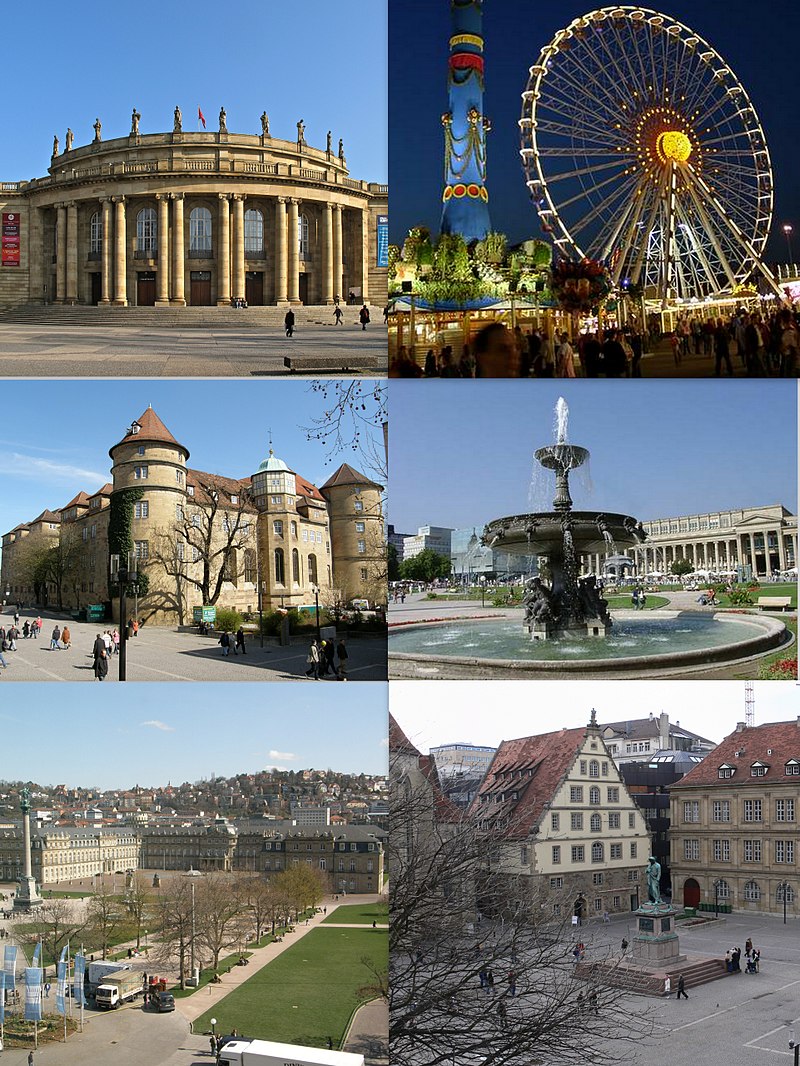
Stuttgart, Germany
Stuttgart is the capital and largest city of the German state of Baden-Württemberg. Stuttgart is located on the Neckar river in a fertile valley known locally as the “Stuttgart Cauldron.” It lies an hour from the Swabian Jura and the Black Forest. Its urban area has a population of 609,219, making it the sixth largest city in Germany. 2.7 million people live in the city’s administrative region and another 5.3 million people in its metropolitan area, making it the fourth largest metropolitan area in Germany. The city and metropolitan area are consistently ranked among the top 20 European metropolitan areas by GDP; Mercer listed Stuttgart as 21st on its 2015 list of cities by quality of living innovation agency 2thinknow ranked the city 24th globally out of 442 cities and the Globalization and World Cities Research Network ranked the city as a Beta-status world city in their 2014 survey.

Since the 6th millennium BC, the Stuttgart area has been an important agricultural area and has been host to a number of cultures seeking to utilize the rich soil of the Neckar valley. The Roman Empire conquered the area in 83 AD and built a massive castrum near Bad Cannstatt, making it the most important regional centre for several centuries. Stuttgart’s roots were truly laid in the 10th century with its founding by Liudolf, Duke of Swabia, as a stud farm for his warhorses. Initially overshadowed by nearby Cannstatt, the town grew steadily and was granted a charter in 1320. The fortunes of Stuttgart turned with those of the House of Württemberg, and they made it the capital of their county, duchy, and kingdom from the 15th century to 1918. Stuttgart prospered despite setbacks in the Thirty Years’ War and devastating air raids by the Allies on the city and its automobile production during World War II. However, by 1952, the city had bounced back and it became the major economic, industrial, tourism and publishing centre it is today.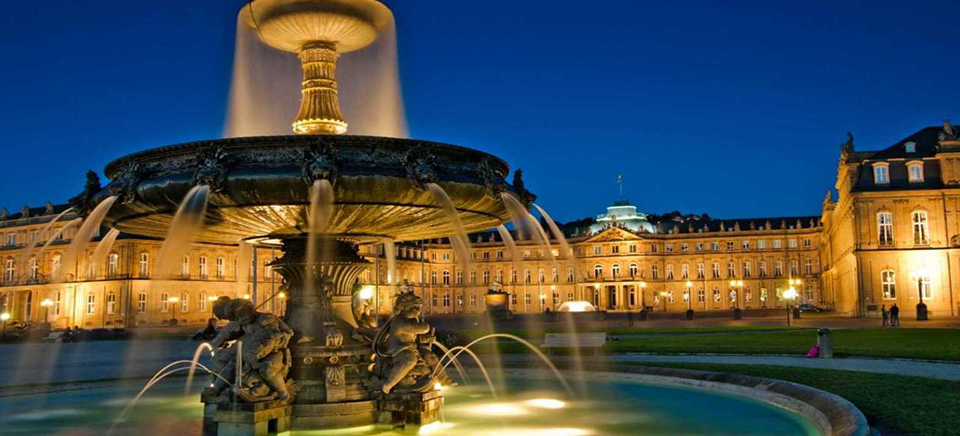
Stuttgart is also a transport junction, and possesses the sixth-largest airport in Germany. Several major companies are headquartered in Stuttgart, including Porsche, Bosch, Mercedes-Benz, Daimler AG, and Dinkelacke.
Stuttgart is unusual in the scheme of German cities. It is spread across a variety of hills (some of them covered in vineyards), valleys (especially around the Neckar river and the Stuttgart basin) and parks. This often surprises visitors who associate the city with its reputation as the “cradle of the automobile”. The city’s tourism slogan is “Stuttgart offers more”. Under current plans to improve transport links to the international infrastructure (as part of the Stuttgart 21project), the city unveiled a new logo and slogan in March 2008 describing itself as “Das neue Herz Europas” (“The new Heart of Europe”). For business, it describes itself as “Where business meets the future”. In July 2010, Stuttgart unveiled a new city logo, designed to entice more business people to stay in the city and enjoy breaks in the area.
Stuttgart is a city with a high number of immigrants. According to Dorling Kindersley’s Eyewitness Travel Guide to Germany, “In the city of Stuttgart, every third inhabitant is a foreigner.” 40% of Stuttgart’s residents, and 64% of the population below the age of five, are of immigrant background.
 Dream Travel